Monday, February 20, 2012
About the Pre-Raphaelites
The Pre-Raphaelites were formed secretly in 1848 by seven young artists, painters, critics, poets, and sculptors alike, who hoped to create a new British art. These artists were James Collinsin, William Holman Hunt, John Everett Millais, Dante Gabriel Rossetti, William Michael Rossetti, Frederic George Stephens, and Thomas Woolner. Dissatisfied with the contemporary academic art, the artists decided to emulate the art of the late middle ages, before the time of Raphael. This art was characterized by minute depiction of detail,vivid colors, and a subject matter of a noble, religious, or moralizing manner. During an era of political uprise, industrialization, and social struggles, the Pre-Raphaelites desired to spread an idea of artistic renewal and moral reform. Their ultimate quest was to find "truth in nature."

Sunday, February 19, 2012
Lady of Shalott - J. W. Waterhouse

"And at the closing of the day she loosed the chain, and down she lay;
The broad stream bore her far away, The Lady of Shalott."
The broad stream bore her far away, The Lady of Shalott."
The Lady of Shalott
John William Waterhouse
John William Waterhouse
1888 - Oil on Canvas
Tate Gallery, London
This painting of the Lady of
Shalott is the first of three done by John William Waterhouse. Though Waterhouse
was not born when the Pre-Raphaelite Brotherhood was formed, his pieces
in the Victorian period are the finest work influenced by the Pre- Raphaelites at that late period. The Lady of Shalott depicts the story of Tennyson’s poem by the same name. Tennyson’s poetry became particularly popular inspiration for the works of the Brotherhood.The story tells of a woman cursed to live in a castle on an island near Camelot and never able to look out of the tower. She is only allowed to view the outside world through reflections on a mirror, which she depicts in her tapestries. She grows quite lonely and longs for love, especially after seeing Sir Lancelot in her mirror. She decides she must see him directly and looks out of her window, fulfilling the curse, unraveling her tapestry and cracking her mirror. Waterhouse’s painting captures the moment when the Lady of Shalott flees the tower in an attempt to sail toward Camelot, still holding her newly loosened chains; however, she dies before reaching her destination. The three candles (two blown out and one still lit) on her boat symbolize the short time she has left before her death. The woman is dressed in white, and has with her a crucifix and rosary, suggesting her purity and spirituality. The tragic love illustrated by Tennyson's poem and Waterhouse's painting appealed to the Pre-Raphaelites and their followers as one of the themes they favored most. Waterhouse also portrays the passive role of the woman that was commonly depicted by Pre- Raphaelites in their work. The aspects of spiritual nobility and the melancholy of the sorrowful aspects of love are also shown through the story and detail of the painting. The Lady of Shalott illustrates the woman who abandons her social responsibility in her pursuit of love and shows the continaution of Pre -Raphaelite style, even after the time period of the Brotherhood.
in the Victorian period are the finest work influenced by the Pre- Raphaelites at that late period. The Lady of Shalott depicts the story of Tennyson’s poem by the same name. Tennyson’s poetry became particularly popular inspiration for the works of the Brotherhood.The story tells of a woman cursed to live in a castle on an island near Camelot and never able to look out of the tower. She is only allowed to view the outside world through reflections on a mirror, which she depicts in her tapestries. She grows quite lonely and longs for love, especially after seeing Sir Lancelot in her mirror. She decides she must see him directly and looks out of her window, fulfilling the curse, unraveling her tapestry and cracking her mirror. Waterhouse’s painting captures the moment when the Lady of Shalott flees the tower in an attempt to sail toward Camelot, still holding her newly loosened chains; however, she dies before reaching her destination. The three candles (two blown out and one still lit) on her boat symbolize the short time she has left before her death. The woman is dressed in white, and has with her a crucifix and rosary, suggesting her purity and spirituality. The tragic love illustrated by Tennyson's poem and Waterhouse's painting appealed to the Pre-Raphaelites and their followers as one of the themes they favored most. Waterhouse also portrays the passive role of the woman that was commonly depicted by Pre- Raphaelites in their work. The aspects of spiritual nobility and the melancholy of the sorrowful aspects of love are also shown through the story and detail of the painting. The Lady of Shalott illustrates the woman who abandons her social responsibility in her pursuit of love and shows the continaution of Pre -Raphaelite style, even after the time period of the Brotherhood.
Saturday, February 18, 2012
Christ In the House of his Parents
 | |||
| "And one shall say unto him, What are these wounds in thine hands? Then shall he answer. Those with which I was wounded in the house of my friends" |
John Everett Millais
1849-1850
Oil on Canvas
Tate Gallery, London
The caption below the picture, from the Old Testament, was placed with the original painting, often making the work of art seen as prefiguring Christ's crucifiction. Millais actually based this painting on a carpenter's shop in Oxford street. In this painting, the artist placed several symbols of crucifiction, including wood, nails, cut in Christ’s hand, and the blood in his foot. After finishing the painting, Millais was viciously attacked by the public by portraying the holy family as "ordinary."
Friday, February 17, 2012
 |
| The Girlhood of Mary Virgin Dante Gabriel Rossetti 1848-9 - Oil on canvas Tate Gallery, London
This piece is Dante Gabriel
Rossetti’s first major oil painting and his first true piece of Pre -
Raphaelite art. Holman Hunt oversaw Rossetti’s work on this picture and this is
the first piece to be exhibited with the mysterious initials PRB (Pre -
Raphaelite Brotherhood) on it. Rossetti initially wanted to include The
Girlhood of Mary Virgin as part of a triptych, but he soon realized the
enormity of the work. The Virgin Mary is shown in this painting as a young
girl, working on an embroidery with her mother, St. Anne, while her father, St.
Joachim, is pruning the vine. The picture is full of symbolic references to the
life of Christ: the dove which alludes to the Holy Spirit, the vine to
Christian truth, the rose on the windowsill, and the lamp as a symbol of piety.
The lily, symbolizing Mary's purity, is being grown in a pot and carefully
tended by a child angel. This refers to the Angel Gabriel who will later
announce to Mary that she is to bear the Son of God. The palm branch on the
floor and thorny briar rose on the wall allude to Christ’s Passion and the
books to the virtues of hope, faith and charity. Though Rossetti was guided through the
creation of this piece of work, the prominent foreground and the hazy background
are in contrast to the carefully defined landscapes of both Rossetti’s mentors,
and do not exactly flow with the newly formed Pre - Raphaelite style.
|
John Ruskin's Modern Painters
Modern Painters was written in 1843 by John Ruskin, a english art critic. The Pre-Raphaelite brotherhood was inspired by his words to "go to Nature in all singleness of heart, rejecting nothing, selecting nothing, and scorning nothing." With these words, the artist developed techiniques and skill to find "truth to nature".
a link to John Ruskin's Modern Painters:
http://www.lancs.ac.uk/fass/ruskin/empi/index.htm
a link to John Ruskin's Modern Painters:
http://www.lancs.ac.uk/fass/ruskin/empi/index.htm
Thursday, February 16, 2012
The Last of England

'The educated are bound to their country by quite other ties than the illiterate man, whose chief consideration is food and physical comfort"
Ford Madox Brown
1855
Oil on Canvas
The idea of painting the theme of emigration first struck Brown when he went to Gravesend to bid farewell to his fellow Pre-Raphaelite, Thomas Woolner, who was emigrating to Australia. "The Last of England" focuses on the tragedy of the exiled middle class.Brpwn went through great agony painting this picture, modeling with his wife in all weather, even snow. The Pre-Raphaelite focus on minute detail is evident in this painting, so much that it took Brown four weeks to complete just the ribbon on the woman's bonnet.
Tuesday, February 14, 2012
Thursday, February 9, 2012
Ophelia - John Everett Mallais
 | |
| Ophelia by John Everett Mallais |
Ophelia was painted in 1851 by Sir Everett John Mallais. It is arguably Mallias most renowned painting. Typical of Pre-Raphaelite art, the subject matter pertains to a work of literature, in this case, Hamlet. The character ophelia was Hamlet's spurned lover driven mad after the murder of her father at the hand of Hamlet. While wandering through the woods, Ophelia drowns in the creek . Her sudden and mysterious death is a suspected suicide. However, Mallais's painting seems indifferent to the tragedy. instead, Mallais's attention to detail throughout the work as a whole marginalizes the subject, Ophelia. In fact, the landscape surrounding Ophelia was painted first. The landscape was painted in separate sections, giving significance to every corner. Mallais filled in the figure only when the background was perfected. The order thus contradicts the technique of academy art, where the subject matter was the primary focus of the work. "This part by part execution was quite opposed to traditional 'high art' working methods, which demanded the artist be mindful, when working on individual parts, of their subordination to a larger conceptual whole (Mcgraw.)" Following the Pre-Raphaelite technique, Mallais painted directly from nature. Mallais then had his model, Elizabeth Siddall, pose in a bath tub to capture the effect of floating. It is believed that Siddall became ill after posing in the frigid water for hours.
Tuesday, January 31, 2012
Works Cited
Works Cited
Curnow,
Harriet. "Tate | Work In Focus: Millais's Ophelia." Tate: British and
International Modern and Contemporary Art. The Tate Museum. Web. 17 Feb. 2012. http://www.tate.org.uk/ophelia/.
“The Girlhood
of Mary Virgin.” British Broadcasting Corporation. N.p., Mar. 2008. Web.
17 Feb. 2012.
Hawksley,
Lucinda. Essential Pre - Raphaelites. Fulhum: Parragon, 1999. Print.
Meagher,
Jennifer. “In Heilbrunn Timeline of Art History.” The Metropolitan Museum of
Art. N.p., 2000. Web. 17 Feb. 2012.
“Pre -
Raphaelite Collection.” Tate . Tate Gallery, n.d. Web. 17 Feb. 2012.
Prettejohn,
Elizabeth. The Art of the Pre - Raphaelites. Millbank : Tate Gallery
Publishing Limited, 2000. Print.
Showalter,
Elaine. Representing Ophelia: Women, Madness, and the Responsibilities of
Feminist Criticism. Representing Ophelia: Women, Madness, and the
Responsibilities of Feminist Criticism. 1994. Web. 18 Feb. 2012.n
Trippi, Peter.
“Waterhouse: The Lady of Shalott.” University of Chicago. N.p., n.d.
Web. 14 Feb. 2012.
Wood,
Christopher. The Pre - Raphaelites. New York: The Viking Press, 1981.
Print.
Sunday, January 8, 2012
women in preraphaelite art
Women in Pre-Raphaelite Art
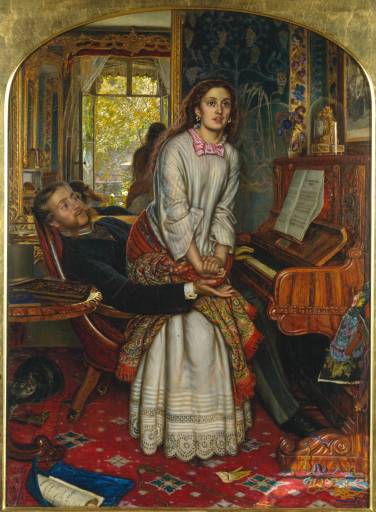 |
| The Awakening of Conscience - William Holman Hunt
Women were ubiquitous in Pre-Raphaelite art. Their presence often reflected the social attitudes toward women in Victorian England. During this period, it was common for women to be categorized as either the good, virgin wife or the promiscuous femme fatale . This overly simplistic view prevented women from becoming active, individual, and equal members of society. Pre-Raphaelite artist represented the theme of the 'fallen women' through mythological or historical character (Hylas and the Nymphs) and through modern urban concerns. The Awakening of Conscience shows a women raising from a man's lap. The decor of the room is guady and overdone, suggesting that the home belongs to a mistress. "The kitsch setting produces a feeling of distaste or embarrassment that drives home the moral horror of the scene." The women also wears rings all all fingers except for her ring finger. While this women would normally be subject to harsh ridicule as the 'fallen' women, there is a sudden change in her demeanor. She moves away from the man and looks upward. There is a feeling of hope and redemption, hence the title the Awakening of Conscience. When the painting first showed, John Ruskin, art critic, felt it was misunderstand and stated "There is not a single object in all that room, common, modern, vulgar…but it becomes tragical, if rightly read…That furniture so carefully painted, even to the last vein of rosewood – is there nothing to be learnt from the terrible lustre of it, from its fatal newness; nothing there that has the old thoughts of home upon it, or that is ever to become a part of a home?” Both Hunt and Ruskin criticize the development of the urban mistress during the time of rapid industrialization. Hunt used Annie Miller, a prostitute, as his model. He took Annie as a lover and worked to better her position in society. The scene would seem to parallel Annie's relationship with the artist himself. However, the affair ended after Hunt learned of her infidelity with fellow Pre-Raphaelite, Dante Rossetti.
|
 |
| Hylas and the Nympths - John William Waterhouse |
An example of mythology representing the femme fatale
Subscribe to:
Posts (Atom)