Tuesday, January 31, 2012

Works Cited


Works Cited

Curnow, Harriet. "Tate | Work In Focus: Millais's Ophelia." Tate: British and International Modern and Contemporary Art. The Tate Museum. Web. 17 Feb. 2012. http://www.tate.org.uk/ophelia/.

“The Girlhood of Mary Virgin.” British Broadcasting Corporation. N.p., Mar. 2008. Web. 17 Feb. 2012.

Hawksley, Lucinda. Essential Pre - Raphaelites. Fulhum: Parragon, 1999. Print.

Meagher, Jennifer. “In Heilbrunn Timeline of Art History.” The Metropolitan Museum of Art. N.p., 2000. Web. 17 Feb. 2012.
“Pre - Raphaelite Collection.” Tate . Tate Gallery, n.d. Web. 17 Feb. 2012.
Prettejohn, Elizabeth. The Art of the Pre - Raphaelites. Millbank : Tate Gallery Publishing Limited, 2000. Print.
Showalter, Elaine. Representing Ophelia: Women, Madness, and the Responsibilities of Feminist Criticism. Representing Ophelia: Women, Madness, and the Responsibilities of Feminist Criticism. 1994. Web. 18 Feb. 2012.n
Trippi, Peter. “Waterhouse: The Lady of Shalott.” University of Chicago. N.p., n.d. Web. 14 Feb. 2012.
Wood, Christopher. The Pre - Raphaelites. New York: The Viking Press, 1981. Print.

Sunday, January 8, 2012

women in preraphaelite art

Women in Pre-Raphaelite Art

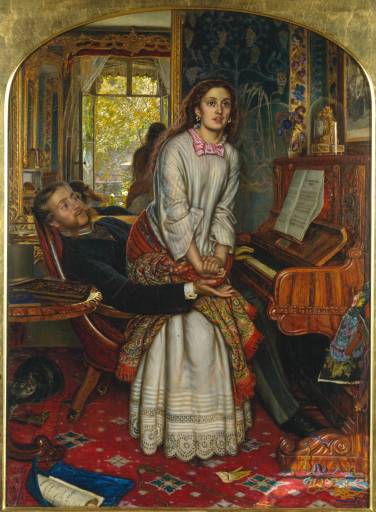
The Awakening of Conscience - William Holman Hunt


Women were ubiquitous in Pre-Raphaelite art. Their presence often reflected the social attitudes toward women in Victorian England. During this period, it was common for women to be categorized    as either  the good, virgin wife or the promiscuous femme fatale . This overly simplistic view prevented women from becoming active, individual, and equal members of society. Pre-Raphaelite artist represented the theme of the 'fallen women' through mythological or historical character (Hylas and the Nymphs) and through modern urban concerns. The Awakening of Conscience shows a women raising from a man's lap. The decor of the room is guady and overdone, suggesting that  the home belongs to a mistress.  "The kitsch setting produces a feeling of distaste or embarrassment that  drives home the moral horror of the scene." The women also wears rings all all fingers except for her ring finger. While this women would normally be subject to harsh ridicule as the 'fallen' women, there is a sudden change in her demeanor. She moves away from the man and looks upward. There is a feeling of hope and redemption, hence the title the Awakening of Conscience. When the painting first showed, John Ruskin, art critic, felt it was misunderstand and stated "There is not a single object in all that room, common, modern, vulgar…but it becomes tragical, if rightly read…That furniture so carefully painted, even to the last vein of rosewood – is there nothing to be learnt from the terrible lustre of it, from its fatal newness; nothing there that has the old thoughts of home upon it, or that is ever to become a part of a home?” Both Hunt and Ruskin criticize the development of the urban mistress during the time of rapid industrialization. Hunt used Annie Miller, a prostitute, as his model. He took Annie as a lover and worked to better her position in society. The scene would seem to parallel Annie's relationship with the artist himself. However, the affair ended after Hunt learned of her infidelity with fellow Pre-Raphaelite, Dante Rossetti. 


Hylas and the Nympths - John William Waterhouse
An example of mythology representing the femme fatale